


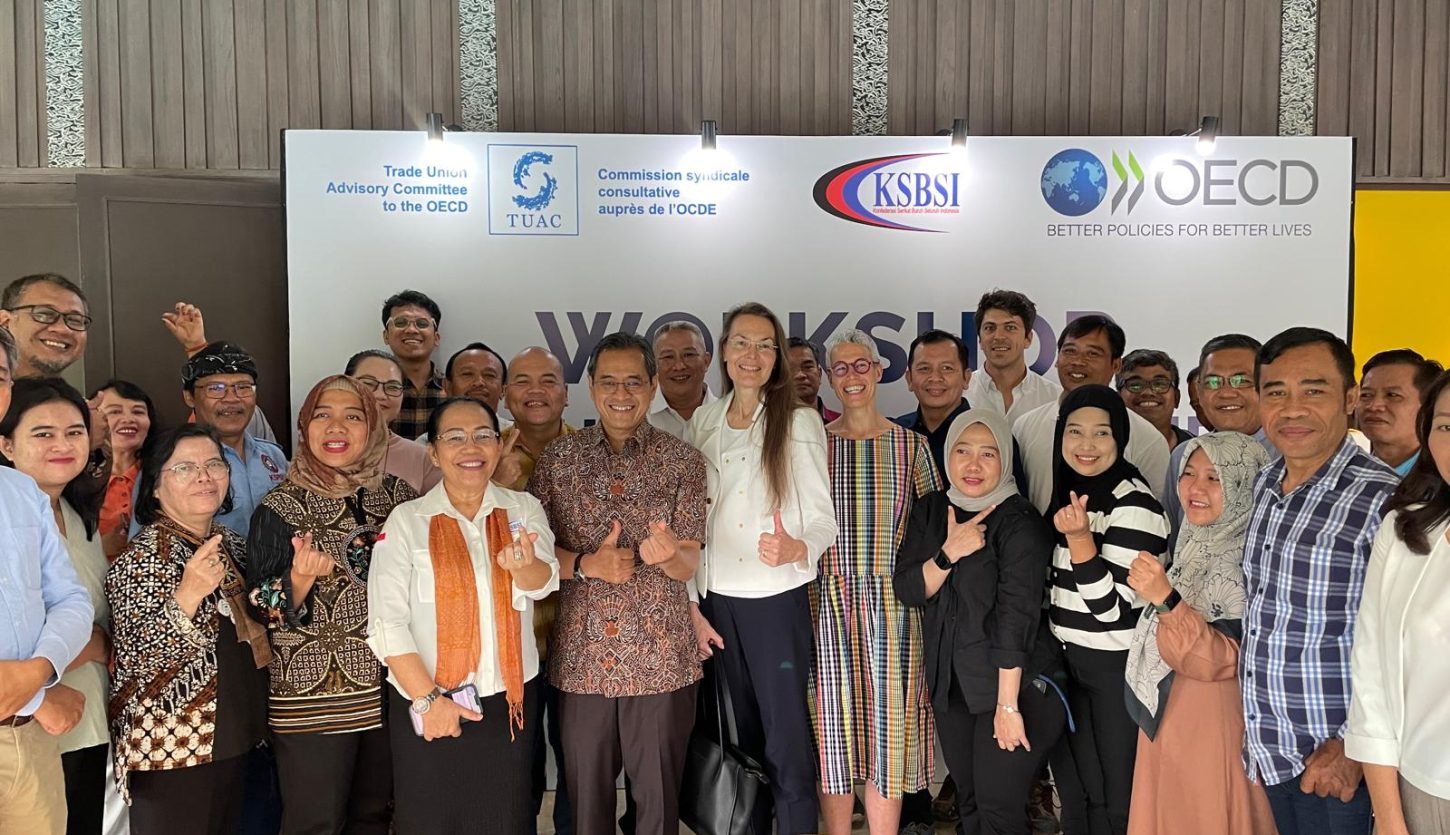
TUAC and its affiliate KSBSI, with support from the OECD, held a joint workshop in Jakarta on 22–23 April to strengthen Indonesian trade unions’ ability to use the OECD Guidelines for Multinational Enterprises to defend workers’ rights, as the country – the first in Southeast Asia to gain OECD accession candidate status – pursues its bid for membership.
The first day opened with a session on the accession process, with OECD representatives outlining its implications for labour rights and responsible business conduct. The Indonesian government highlighted the economic benefits of accession, including attracting foreign direct investment. TUAC set out the specific requirements Indonesia must meet – from full respect of labour rights and effective labour inspection to the establishment of a functioning National Contact Point – and the reforms identified in TUAC’s earlier assessment of Indonesia’s accession bid, including stronger protection against anti-union discrimination and a new employment law grounded in fundamental ILO Conventions.
Trade unionists from six national confederations – across sectors ranging from mining and maritime to garments, healthcare and agriculture – identified job insecurity, inadequate wages and wage theft, union busting, harassment, and a lack of social dialogue as the most pressing challenges they face. TUAC demonstrated how the Guidelines and the National Contact Point complaint mechanism offer concrete avenues to challenge multinational enterprises on labour rights violations along their supply chains.
Workers in several of these sectors also face pressures from the green transition, and the workshop examined how responsible business conduct can help ensure that transition is just – particularly in a country highly vulnerable to extreme weather events. Indonesian trade unionists stressed the importance of businesses consulting workers before taking climate-related decisions, exploring alternatives such as retrofitting and repurposing through investment in skills and training, and providing redress and compensation for those affected. Unions also discussed how to leverage the forthcoming OECD Key Actions on RBC for a Just Transition to ensure multinational enterprises address adverse social impacts of climate action, including when disengaging from emitting activities.
A second day of dialogue brought together unions, employers, government and civil society. Indonesian chamber of commerce KADIN emphasised that compliance with human rights due diligence represents not only an international obligation but a business opportunity, while unions argued that due diligence processes can build social dialogue and sound industrial relations. With the government representative stressing the importance of policy coherence through accession, all participants recognised that social dialogue and genuine stakeholder engagement are essential to credible OECD accession.
The OECD Guidelines are a key tool for trade unions to hold companies accountable and ensure they respect fundamental labour rights. As Indonesia moves towards OECD membership, it is vital that the worker perspective is fully integrated into this process – accession must deliver real improvements for workers, not simply serve as a vehicle for attracting investment.
TUAC has made clear that concrete commitments to protect workers’ rights and establish effective social dialogue are prerequisites for Indonesia’s OECD membership.
