


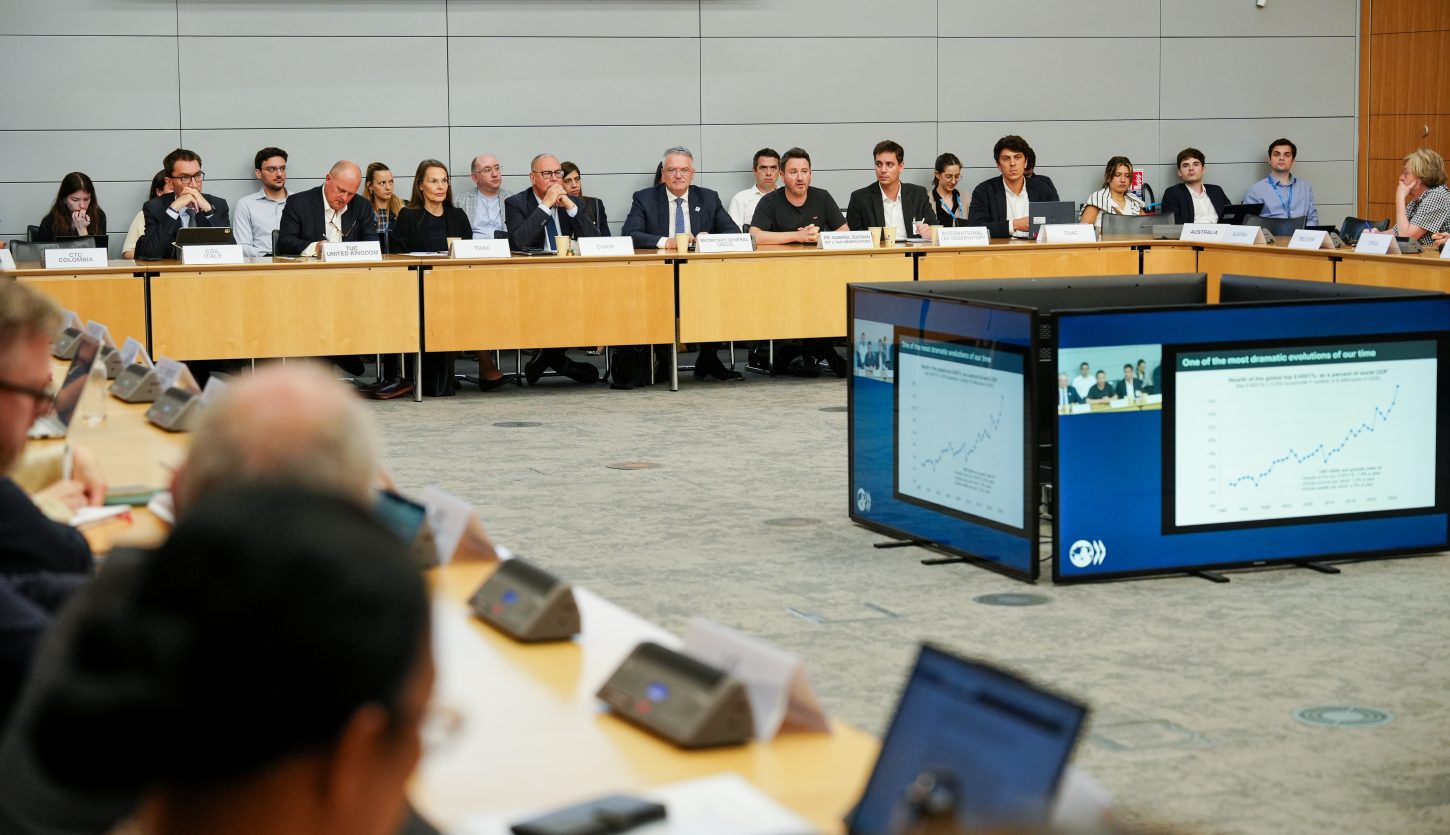
On the eve of the 2026 OECD Ministerial Council Meeting, TUAC convened a high-level dialogue on tackling inequality through fairer taxation, bringing economist Gabriel Zucman together with OECD Secretary-General Mathias Cormann, TUC General Secretary Paul Nowak and Honorary ACV-CSC President Marc Leemans, before a packed room of government representatives, ambassadors and senior officials in the margins of the Ministerial. Zucman illustrated what international tax cooperation can achieve: even a modest 2% minimum tax on the world’s billionaires would raise USD 200–250 billion a year from around 3,000 individuals. For trade unions, that floor is only the beginning of what fair taxation demands.
That argument set the tone for the week. Across every session of the Ministerial, held in Paris on 3–4 June under the theme “Getting Industrial Policies Right for Open Markets, Growth and Prosperity”, TUAC advanced a single case: industrial policy will only deliver shared prosperity if it is built around workers’ interests. In its statement to ministers, A Workers’ Agenda for Industrial Policy, TUAC identified two conditions for success – economic security and a level playing field.
TUAC carried that agenda into every session. TUAC Vice-President Tomoko Yoshino, President of Japan’s JTUC-RENGO, argued that strong labour institutions are not a cost to competitiveness but a source of productivity and stability. The reverse holds too: competing for investment by making labour cheap and insecure erodes the domestic demand that growth ultimately depends on. On industrial support, trade unions pressed for conditions that secure collective bargaining and decent, quality work, and for public investment to reach health and education, not only the strategic sectors that dominate industrial policy. Trade unions further warned that the weaponisation of trade through export bans, restrictions and tariffs is making supply chains fragile, and that easing those tensions is essential to restore predictability on critical materials.
Underpinning these interventions, TUAC challenged the wave of deregulation sweeping OECD countries, insisting that labour and environmental safeguards are critical infrastructure for sustainable growth, too often dismissed as mere red tape. Public money for the green transition, through procurement and subsidies, should be conditional on respect for workers’ rights and collective bargaining, so that decarbonisation creates quality jobs rather than leaving workers to absorb the costs. TUAC also called for stronger enforcement of the OECD Guidelines for Multinational Enterprises, which mark their 50th anniversary this year, and backed fair taxation throughout – urging governments to treat the OECD/G20 global minimum tax as a baseline to build on and to resist the carve-outs that erode it.
Secure jobs, fair taxation and strong rights are not obstacles to a thriving economy – they are what makes one possible. Trade unions came to this Ministerial with a clear agenda, and we will keep pressing governments to deliver it.
Trade unions stand ready to help governments deliver it.
Photo: OECD, “TUAC event: Tackling Inequality and Promoting Social Cohesion through Fiscal and Social Justice”, 2026, licensed under CC BY-NC 3.0 IGO.
