


Economic policy
TUAC represents the voice of labour in the international economic policy debate. Through its engagement at the OECD, TUAC fights for economic policies that create full employment and that give working people a fair share of the wealth they create.
This is done through our engagement on fiscal and monetary policy at the Economic Policy Committee and its Working Party on Macroeconomic and Structural Policy Analysis.
This work is led by Filip Stefanovic and Maciej Kumor. For more information, please contact stefanovic@tuac.org and kumor@tuac.org.
International tax reform – OECD negotiations must continue
On 18 June, the OECD General Secretary released on a statement calling on all countries to remain engaged in the OECD international tax negotiations with a view to reaching a global solution by year end. This statement follows press articles reporting that the United States have withdrawn from the ...
TUAC response to the OECD 2020 Economic Outlook, Issue 1
OECD Economic Outlook: A more pragmatic approach to economic policy at a time of crisis Key findings The first issue of the 2020 OECD Economic Outlook provides a full picture of the economic hardship caused by the COVID-19 and measures taken against the epidemic spread, and the grim outlook for ...
 Download (121.51 KB)
Delivering a recovery built on trust – TUAC Statement on the COVID-19 crisis and the future of the OECD / Pour une reprise fondée sur la confiance
(Version française ci-dessous) The envisaged GDP forecast for 2020 is dreadful: -7.1% at the global level, down to -9.1% in the OECD area. In these circumstances, unemployment in the OECD will almost double this year, from 5.4% in 2019 to 9.4% at the end of 2020. The recovery will be slow and ...
TUAC Plenary marked by COVID-19 – Calls for strong OECD response/ La plénière du TUAC marquée par COVID-19 – Appels à une réponse forte de
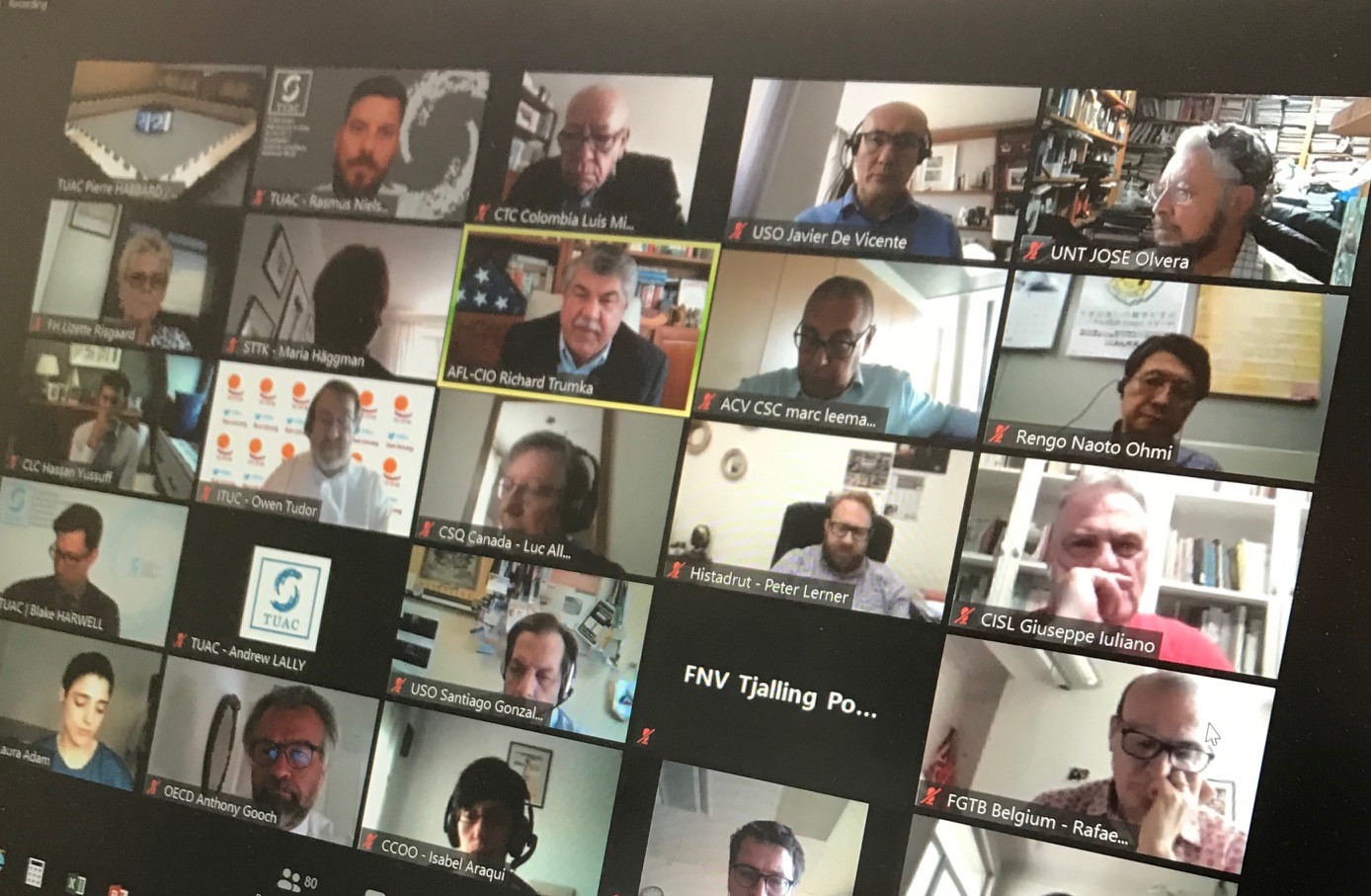
EN (version FR ci-dessous) (versión en español a continuación) On 26 May 2020, the TUAC held its 144th Plenary meeting in the shadow of the COVID-19 crisis. At the meeting, the Plenary discussed the ongoing COVID-19 crisis including its severe impact on economies, employment and workers. Ahead ...
Indicative unemployment forecasts and the importance of collective bargaining in the context of COVID-19 / Prévisions de chômage indicatives et importance de
Indicative unemployment forecasts and the importance of collective bargaining to restore the economy in the context of COVID-19 Paris, 15 May 2020 Key findings The COVID-19 crisis represents an unprecedented threat to the global economy, and the length and impact of containment measures on ...
TUAC comments on the OECD tax and fiscal response to Covid-19/ les commentaires du TUAC sur les réponses fiscales et budgétaires de l’OCDE face à
EN (FR CI-DESSOUS) The OECD center for tax policy has released mid-April a report on tax and fiscal policy in response to the Coronavirus crisis. This report emphasises the need for an expansionary fiscal policy coordinated with broader policy objectives, such as decarbonisation and the ...
