


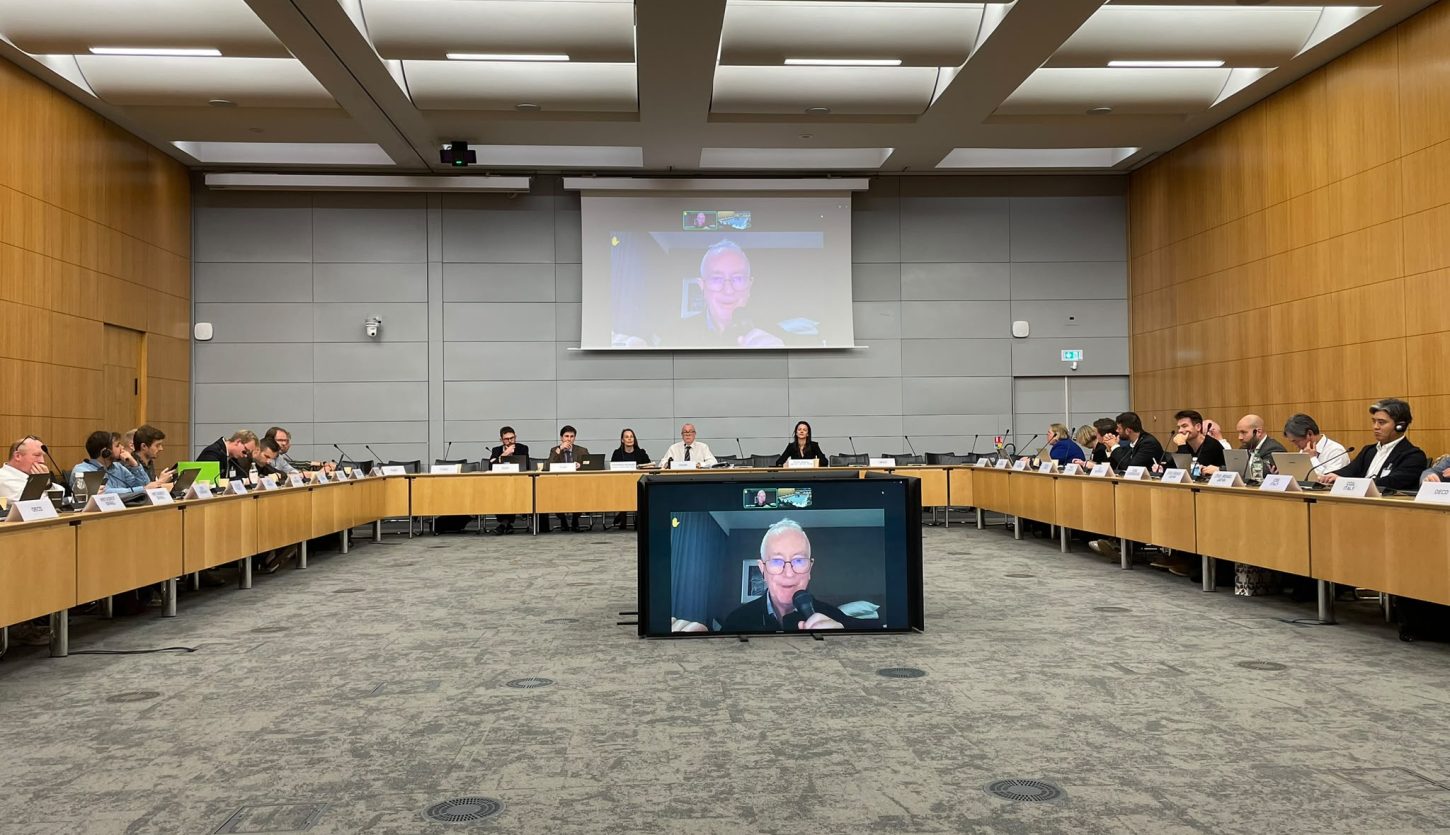
TUAC welcomed economist Steve Keen, Honorary Professor at University College London, to its Working Group on Economic Policy in Paris on 13 October for a discussion on how the economic consequences of climate change are modelled – and what this means for workers. At stake for trade unions is how that modelling shapes the way the costs of a changing climate are shared across society.
The discussion took place against the backdrop of the eleven warmest years on record globally and the hottest summer ever recorded in Western Europe, marked by persistent heatwaves, severe drought and very strong heat stress across more than half of Europe.
Professor Keen presented his research on the economic impacts of climate change, arguing that mainstream economic models significantly underestimate the associated risks and are inconsistent with the findings of climate science.
The OECD has also been working on new approaches, including OECD-CASGEM, a Climate and Adaptation Spatial General Equilibrium Model it has just developed. Rather than looking only at how rising temperatures affect overall GDP, it starts from specific climate impacts in particular places and traces how they spread across regions and countries through production networks, trade and migration.
For trade unions, the question goes beyond methodology: how climate-related economic risks are assessed will influence how early governments act and how well they prepare. Climate impacts do not occur in isolation: they can interact with existing economic vulnerabilities and reinforce inequalities, and for workers the consequences can be felt through jobs, incomes, working conditions, pensions and the public finances that fund social protection.
No model can foresee the future. But when models inform the choices governments make, we need to be confident that they are asking the right questions – and that the risks hardest to quantify are not the ones left out.
TUAC encourages the OECD to build on its climate modelling work by stress-testing the assumptions behind its models and exploring the non-linear, systemic, financial and distributional dimensions of climate risk. Distribution is a key concern for trade unions: aggregate and average estimates can hide very uneven consequences across regions, income groups, genders, sectors and categories of workers. Understanding who is most exposed, who has the resources to adjust and who ultimately bears the cost should be integral to how climate risk is assessed – and to any policy response aimed at a just transition.
