


01 May 2018
The Swedish Job Security Councils – A case study on social partners’ led transitions
The Swedish Job Security Councils are one concrete, existing mechanism in ensuring smooth transitions from one job to another. In existence since the 1970s, they are now covering almost all economic sectors (except companies without collective agreements). This system is an example of how to ensure ...
10 April 2018
L7 Key Demands for the Canadian G7 Presidency/ Principales revendications du L7 à la présidence canadienne du G7
Labour-7 (L7) trade union leaders met with Canadian Prime Minister Justin Trudeau and Ministers Patricia Hajdu (Employment, Workforce Development and Labour), Maryam Monsef (Status of Women), François-Philippe Champagne (International Trade) and Chrystia Freeland (Foreign Affairs) in Ottawa on ...
04 April 2018
L7 Evaluation of the Outcomes of the G7 Innovation and Employment Ministerial Meeting 2018
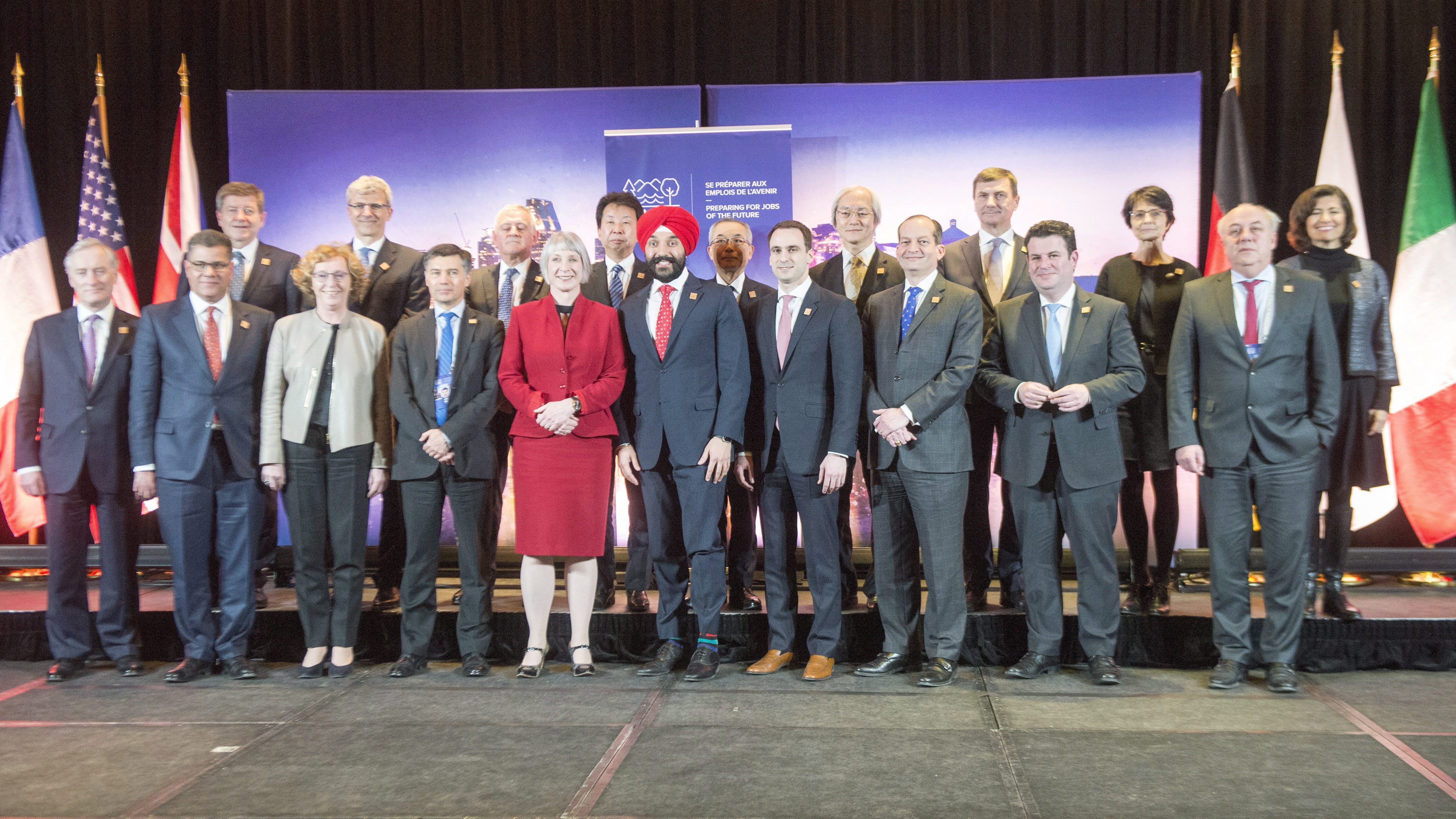
The G7 Innovation and Employment Ministers met in Montréal on 27 and 28 March. The L7 welcomed the cluster approach towards building a joint understanding on how to reconcile the goals of innovation and quality job creation. The L7 was invited to parts of the Employment Ministerial and the joint ...
21 March 2018
Going for Growth 2018: Between Structural Reforms and Inclusive Growth
In the Interim report on “Going for Growth”, released on 19 March, the OECD tries to reconcile its traditional policy of structural reforms and ‘creative destruction’ with an ‘inclusive growth” agenda, where the benefits of growth are shared much more broadly. Read TUAC Comments: ...
13 March 2018
OECD Interim Forecast shows recovery is far from inclusive
Main takeaways The scar of youth unemployment has not healed. The recovery has bypassed younger people. Employment rates of 15 to 24 year old still have to recover substantially in order to reach the pre-crisis level (see graph below). ...

07 March 2018
Ron Blackwell, 1946-2018
Ron Blackwell, former Chief Economist of the AFL-CIO and Chair of the TUAC Working Group on Economic Policy, passed away on 25 February 2018. Ron was a principled trade unionist who harnessed his excellence and experience in economics to defend working people throughout a long career in the ...
22 February 2018
Success for US Hotel Workers at the French NCP – UNITE HERE
At the French NCP’s 2018 Annual Meeting, Jeremy Blasi from UNITE HERE describes how an OECD Guidelines case filed in France helped US hotel workers in Los Angeles to unionise – with support from the French pension funds. My name is Jeremy Blasi. I am a staff attorney with UNITE HERE ...
22 February 2018
“No Progress on Trade Union Rights and Safety in Colombia? No OECD Accession” say Colombian Trade Unionists
Colombian trade unions call for a halt to Colombia’s OECD Accession process in view of the failure to make progress on trade union rights and safety and the Colombian Government’s lack of political will. At a TUAC briefing meeting held at the OECD on 21 February, and attended by ...
20 February 2018
Strengthening the bargaining power of SMEs and their workers
The OECD is holding its SME Ministerial on 22-23 February 2018 in Mexico City. TUAC has inputted to its outcome document and actively participates in the meeting to bring the voice of workers to discussions that are closely related to employment, global value chains, responsible finance and ...
08 February 2018
OECD Fails to Find Evidence of Benefits from International Investment Agreements
Proponents of International Investment Agreements claim that these result in more investment, jobs and incomes. A new OECD paper however finds that there is “surprisingly little evidence” on the validity of this claim. Read more here ...
24 January 2018
Job Vacancy: TUAC Policy Adviser on Corporate Regulation / Offre d’emploi – Conseiller politique du TUAC sur la réglementation des entreprises
The TUAC Secretariat is looking for a Policy Adviser to work on corporate regulation issues. The Job Description and Terms of Reference are attached in English. All qualified applicants are encouraged to apply. The deadline for applications is 12 February 2018 (midnight, CET). ...
12 January 2018
“Schumpeter meets Keynes again” : An OECD-IMF-BIS Conference on Financial Factors slowing down productivity
On the 10th and 11th of January, the OECD joined up with the IMF and the BIS to organise a conference discussing the role of financial policies in explaining the trend of productivity slowing down across the global economy. Several technical research papers, covering different datasets, countries ...
