


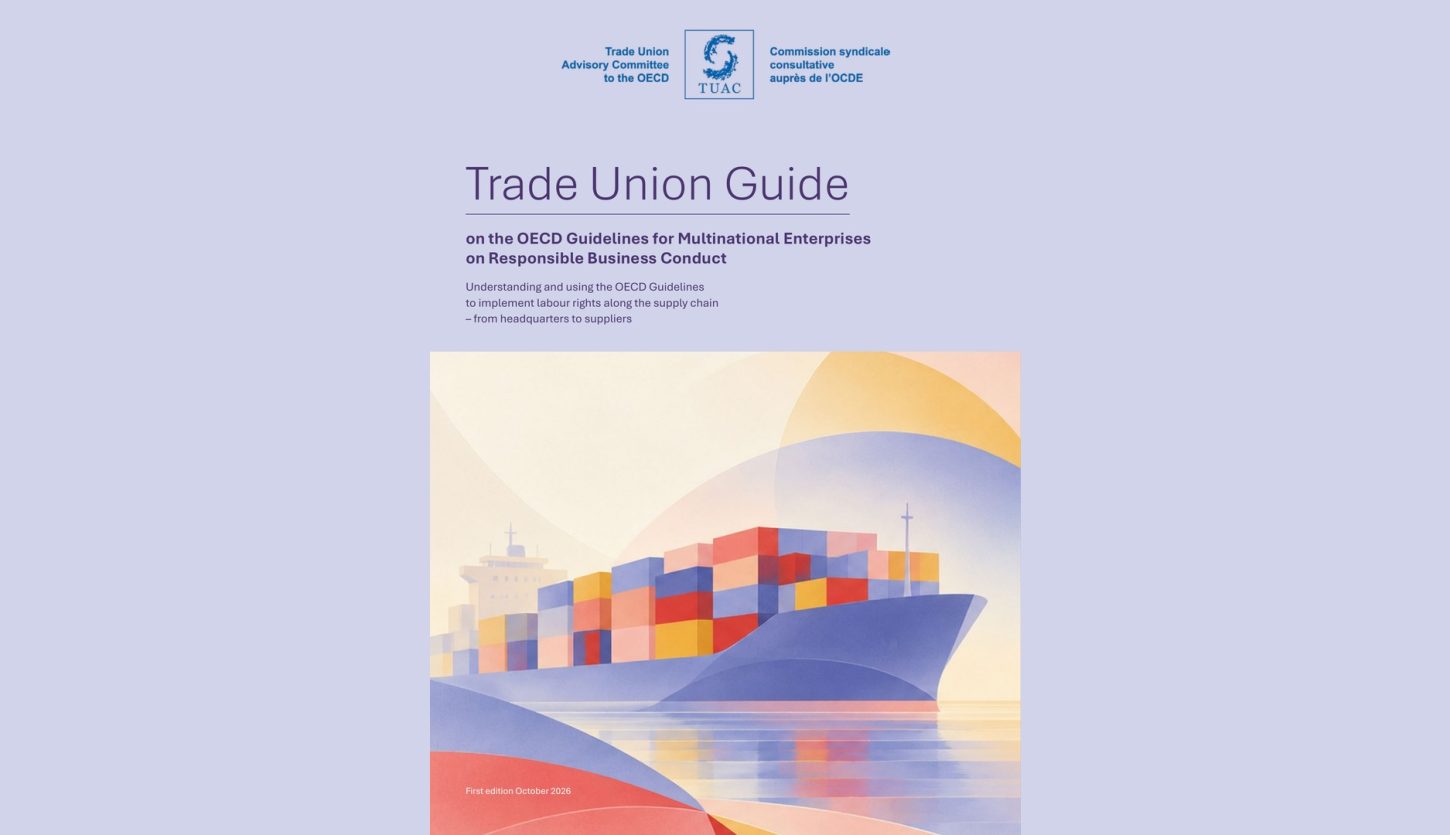
Raising a labour rights complaint against a company under the OECD Guidelines for Multinational Enterprises on Responsible Business Conduct does not require legal counsel and can cover violations anywhere in its supply chain. TUAC’s new Trade Union Guide is practical guidance for workers and trade unions on using that route – and the Guidelines more broadly – to defend labour rights. It was launched today at a meeting of TUAC’s Working Group on Multinational Enterprises.
Governments adopted the Guidelines in 1976 and last updated them in 2023. They set out expectations of multinational enterprises’ conduct towards workers, including respecting the right to organise and bargain collectively. Multinational enterprises must carry out risk-based due diligence to identify, prevent and mitigate violations of workers’ rights, and involve workers and their unions in that process. Fifty-two governments have signed up to the Guidelines, covering around two-thirds of global trade and investment.
Each adhering government has set up a National Contact Point (NCP), which can facilitate remedy through a mediation-like process. Complaints are not limited by borders: one can be filed whenever a supplier or contractor is linked to a company headquartered in an adhering state, even if the violation occurred in a country that does not adhere to the Guidelines.
Preparing a complaint can bring workers together to document what has happened to them and agree what they want to achieve. A complaint also makes the case public, as the NCP publishes a final statement at the end of the process, and a case in one part of a supply chain can build solidarity with workers and unions elsewhere. If mediation does not lead to an agreement, the NCP can make recommendations to the company, which unions can use to organise and to influence it through participation, negotiation and campaigning.
Beyond the NCPs, unions can draw on the Guidelines to back claims in bargaining, demand meaningful involvement in companies’ due diligence, shape company policies and push for better working conditions, including forming a union.
None of this works unless workers know their rights and the instruments that protect them, so the Guide is written for the union practitioners who will use it on the ground – delegates, representatives and organisers at every tier of the supply chain. It covers the Guidelines’ chapter on employment and industrial relations and takes readers through a complaint step by step, from preparation to submission, with checklists and fact sheets for easy use. Versions in other languages will follow shortly. TUAC has also published a companion brief, Responsible Business Conduct for a Just Transition, available in English, French and Spanish.
The OECD Guidelines are the only government-backed international standard on responsible business conduct with their own grievance mechanism, which makes them one of the most valuable tools trade unions have. We hope this guide will support workers in their struggle to safeguard workers’ rights and improve working conditions.
 Download (797.99 KB)
